
10 Ways to Spot Generative AI Art
Here at Unvale, we're 100% AI-free, and one of our biggest defenses against AI right now is our team.

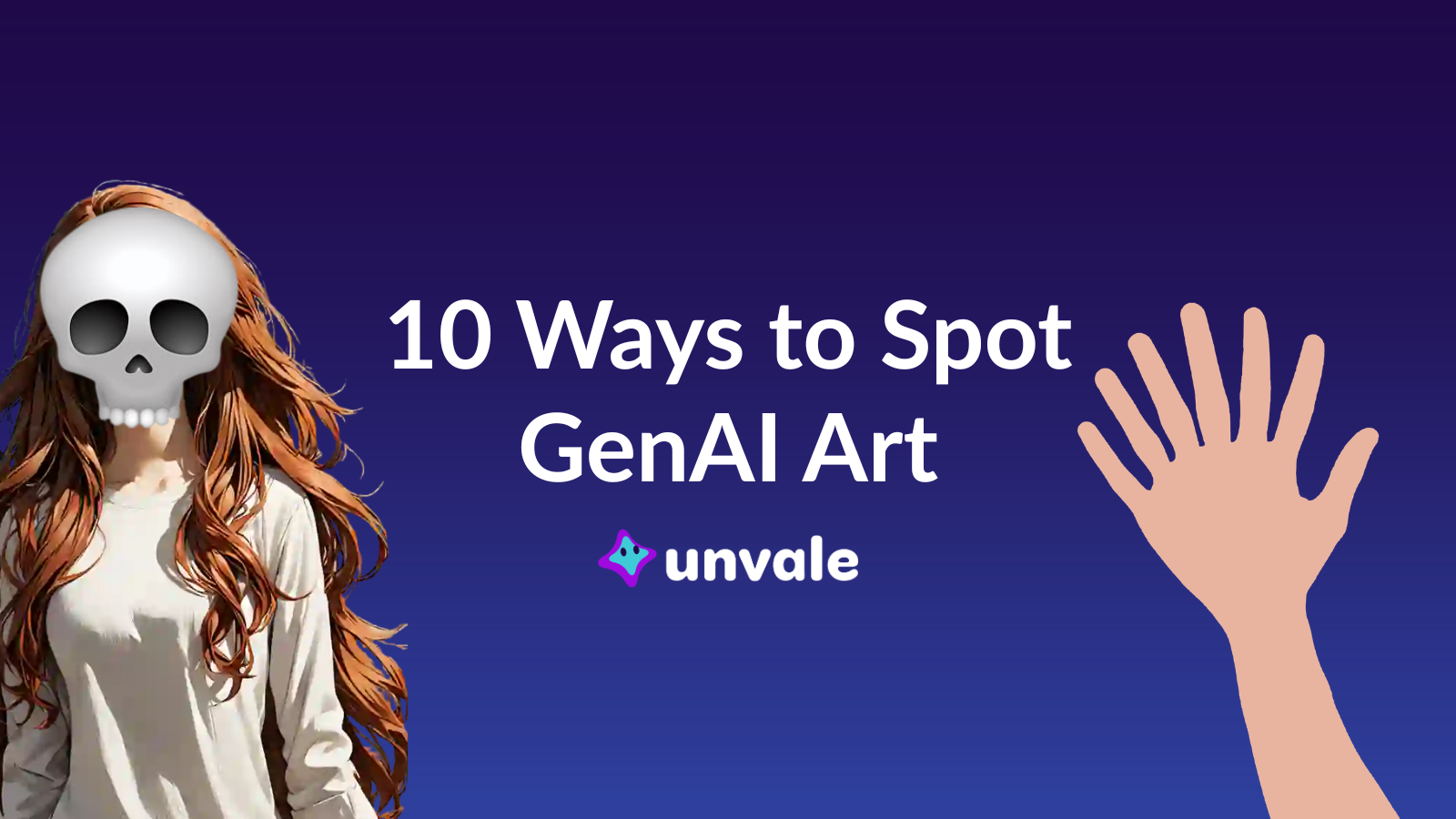
Unvale is 100% AI-free, and one of our biggest defenses against AI art is our team. We manually review every AI art report that comes in and remove any art that doesn't appear human-made. If you've ever wanted to help remove AI art from the platform, or just want to not be fooled by it elsewhere, here's what to look for.
1. The Hands Are All Wrong
This is a classic tell, and it's still the most reliable one. AI generators have historically – and often hilariously – struggled with hands. Watch out for:
- Too many fingers (or not enough)
- Fingers that blend together or appear fused
- Extra joints that bend the wrong way
AI has gotten better at creating realistic arts, but hands are still the first thing worth looking for but hands are still a great first thing to check when something feels "off" about a piece of art.
2. Symmetrical Eyes
Real faces are asymmetrical. Noses can be crooked, one eye may sit slightly lower, and eyebrows are often sisters, not twins. AI tends to over-correct for this and produce faces that are eerily symmetrical. This reads as unsettling, even when you can't immediately say why.
This is the uncanny valley: something that looks almost human, but not quite. A lot of AI-generated faces land there. If a face looks like a supermodel crossed with a wax figure, it's worth a second look.
3. Hair That Defies Physics
AI-generated hair often looks good at a glance, but falls apart on closer inspection. Look for:
- Strands that pass through shoulders, clothing, or other people
- Hair that floats or has no clear origin at the scalp
- Hair blending unnaturally into a background or object
Curly and coily textures are especially challenging for AI to render. If curls appear to be more of a repeating pattern than actual, organic hair, that's a red flag.
#4: Backgrounds with architectural chaos
AI images often look convincing in the foreground, but they fall apart in the background. Some examples include:
- Shelves, bookshelves, or cabinets won't align or may be blurry
- Lines on stairs, railings, or doorways often aren't parallel
- Text on signs, books, bottles, or storefronts is almost always illegible
If a cozy coffee shop scene has beautiful lighting and a perfect latte in the foreground but the bookshelf in the background looks like it was stacked by someone with fever dreams, that's AI.
#5: Fabric and clothing that doesn't follow gravity
Real clothing wrinkles. It responds to the body wearing it and to gravity. AI-generated clothing often looks like it was painted on; it hugs the body unnaturally, drapes in ways that don't make physical sense, or transitions into skin or background without a clear edge.
Buttons are also good to take a look at. They're often off-center, duplicated, floating slightly above the fabric, or absent entirely where they should be.
#6: Jewelry and accessories that aren't fully there
This one is always interesting. AI struggles to generate accessories with consistent logic. Earrings might be two completely different styles, a necklace might pass through a collar, and glasses may seem embedded in the face rather than sitting on it.
The more complex the accessory (like a statement necklace, a layered bracelet stack, an elaborate crown), the more likely it is to be garbled.
#7: The lighting doesn't come from anywhere
Experienced artists know that light has a source. They draw shadows, bright spots, and you can see light in reflections. AI often produces images where the lighting feels too encompassing. Everything is well-lit and beautiful, but if you try to find where the light is coming from, it falls apart.
With genAI art, shadows may not match between the subject and the background. It's subtle, but once you start looking for it, you won't be able to stop.
#8: Everyone looks like a stock photo model
This is the harder one to quantify, but it's real. AI has been trained on a lot of stock photography, and it shows. AI-generated people in artwork tend to look:
- Ethnically ambiguous in a way that feels calculated
- Weirdly ageless in a way you can't quite explain
- Unblemished (no pores, under-eye circles, or imperfections)
- Like their expression is "fake" or forced
Real characters have weird teeth and uneven skin and expressions that give them a personality. AI characters don't.
#9: Reverse image search
This one isn't always reliable, but it's worth considering. If someone is willing to use genAI for their character art, they likely are willing to steal art from somewhere else. If you suspect a piece of art is AI, you can always use reverse image search on Google to see if it exists on another site where it may have an AI tag. On the other hand, if you are able to find another platforms the artist has posted the image on, you might be able to compare it to the style in their other artwork, see a work-in-progress video, or just verify that they don't solely rely on an AI tool. It won't always work, but it's an option!
#10: Ask yourself: does this look made?
This is the most subjective tip, but I think it's also the most important. Real art shows skill, decisions being made, and effort. You can see where the artist chose to add detail and where they didn't.
AI images are generated, not made. They're the average of millions of inputs, not one person's point of view. They often are overly generic, like:
- A scene is vaguely European but not a specific city
- A character is beautiful but you can't tell anything about them from the design
- A bouquet of flowers is perfectly arranged, not a leaf out of place
If you're looking for an escape from generative AI art, Unvale is committed to being 100% AI-free. We'd love to have you! We even block many of the robots that train AI tools, and we plan to add even more protections in the future. Sign up on our website or download our new mobile app!